
Showing posts with label mls - supporters. Show all posts
Showing posts with label mls - supporters. Show all posts
Sunday, December 3, 2017

Monday, November 6, 2017

Wednesday, October 25, 2017

Thursday, October 27, 2016

Monday, July 25, 2016

Monday, May 23, 2016
Wannabe MLS Hooligans Are Adopting The Worst Of Soccer Culture

(by Justin Block huffingtonpost.com 5-23-16)
Before the New York Red Bulls and NYCFC match kicked off at Yankee Stadium on Saturday, two incidents between rival fans sparked police involvement. First, seen in the video above captured by Bleacher Report UK’s Garry Hayes, an NYCFC fan and a Red Bulls fan exchanged missing punches while the two sides taunted each other.
Elsewhere outside of Yankee Stadium, in a separate incident, the tension between fan groups continued. When Red Bulls supporters arrived en masse to Yankee Stadium before kickoff, they had a standoff against NYCFC fans, hurling insults and bottles. They made a scene, and frankly, the whole thing looked pretty lame.
So what’s the beef here? Why are these two groups of fans fighting? It can’t be over a May 2015 noise complaint against NYCFC fans on the PATH train, right?
As it stands, the rivalry is based on where the two teams play more than anything. Despite having “New York” in their name, the New York Red Bulls actually play in the Red Bull Arena in Harrison, New Jersey. NYCFC, on the other hand, make a point to display their pride in making New York City their home, temporarily playing in Yankee Stadium as they mine New York City’s boroughs for land to build a soccer stadium on. It’s not dissimilar to how the NFL’s New York Jets and Giants share MetLife stadium in the swamps of New Jersey’s Meadowlands.
Geographically, that’s set up the “Hudson Derby” beef between fan bases: NYCFC actually plays in New York City and its fans don’t let Red Bulls fans forget that. Red Bulls fans give NYCFC fans hell for playing their soccer on top of a baseball field and for signing aging European stars — a transfer tactic MLS fans want to see less of.
None of these gripes, however, are authentic or deeply rooted in any way. They’re all superficial, stemming from how the two clubs market the supposed “rivalry.” Saturday’s match followed a week of MLS and club marketing efforts known as “Rivalry Week.” Inadvertently, MLS may have unintentionally incited these incidents by playing up a non-rivalry rivalry. Essentially, the two divisions of New York soccer fans have been fed a narrative to get them psyched up for the match. And with NYCFC still developing their own fan culture in their second season of play, it’s easy bait for fans to take.
And they’ve bit hard. Saturday’s events aren’t the first time the two sides have gone after each other. In August 2015, AP soccer writer Rob Harris captured footage of NYCFC fans and Red Bulls fans fighting and throwing signs at each other outside of a Red Bulls’ supporters bar in Newark, New Jersey. The pre-game altercation was eventually broken up by a few police sirens.
All of this is to say: There is no New York soccer rivalry. The two teams’ wannabe hooligans or “Ultras” are misguided, lame, dangerous and, most of all, seriously unoriginal.
The way the fans have gone about expressing their hostilities is ripped straight from European soccer’s hooligan fan culture, specifically England’s. In Harris’ video, fans can be heard chanting “WHO ARE YA?” at each other in English accents. In Hayes’ tweet, he drew a parallel between England’s deadly hooligans in the ‘80s and what happened on Saturday. These aren’t good looks for either team, and should the violence persist, MLS as a whole, either.
Soccer hooliganism is still going strong in European countries like Turkey, where the violence is threatening their top-flight league’s existence, much like England’s hooligans in the ‘80s. During that time, fan violence in England was so widespread that many people were killed or seriously injured; attendance began to drop as people steered away from the hateful cauldrons around city stadiums. Prime Minister Margaret Thatcher even set up a “war cabinet” to combat hooligans and save English soccer from itself. It worked, and hooliganism has faded in England while the Premier League has risen to the top of international sport.
But do NYCFC and Red Bulls supporter groups want to go down that path? Their behavior looks especially bad compared to how fans act during MLS’ premier rivalry between the Portland Timber and Seattle Sounders. Those two cities have a longstanding rivalry dating back to the ‘70s, giving each fan base’s culture a historical anchor point and authenticity. Moreover, each team’s supporters are simply spirited, not violent. And because of that, MLS loves to point to their derby match as their best overall product.
Although I didn’t personally see either of Saturday’s brawls, I attended the match and came away impressed with the in-game atmosphere. When I spoke to an NYCFC rep during the match, they noted that although the turned-up atmosphere gave it that rivalry feel, the matchup couldn’t possibly be a rivalry, yet — NYCFC is 0-4 against the Red Bulls, scoring an aggregate of four goals to Red Bulls’ 17. Especially in the wake of NYCFC’s 7-0 home defeat on Saturday, they probably need to beat the Red Bulls first before their fans can stake a fierce, competitive claim as their rivals. Just as it is with the New York Knicks and Brooklyn Nets, there’s no real competitive rivalry if the teams aren’t good.
Standing outside of the stadium post-match, an NYCFC fan and a Red Bulls supporter began bantering at each other. The NYCFC fan only had curses to hurl. The Red Bulls fan had the last word: “You lost 7-0 and we’re up 17-4 on you guys, a**hole.”
Given the passion and excitement these fans have invested into their clubs, a true rivalry is indeed brewing in New York professional soccer. But to get there, fans need to kick-out wannabe English hooliganism, take in a few decently competitive matches and organically let the rivalry unfold.
Stop forcing it, fans.
-------------------
http://www.huffingtonpost.com/entry/wannabe-mls-hooligans-are-adopting-the-worst-of-soccer-culture_us_5743285ce4b0613b512ad621
Sunday, May 1, 2016

Saturday, April 16, 2016
Houston Dynamo's new Zona Naranja proves a hit with supporters

(by Phil West mlssoccer.com 4-13-16)
Sunday’s nationally televised match between the Houston Dynamo and the Seattle Sounders showcased two of the league’s most intriguing (and some might say confounding) teams, ending in a 1-1 draw. But it also showed off some exciting developments for fans of Houston, the home team that night.
After a series of off-season meetings with club officials, Dynamo supporters' groups moved from two sections along the end line on the stadium’s southwest side, which they were in danger of outgrowing. Now they've got new digs, the Zona Naranja, a more spacious upper deck underneath the scoreboard at the opposite end of the stadium, encompassing Sections 215-217.
It was a trade-off that the supporters groups determined had net positives. There would be opportunities to create tifo that could be seen throughout the stadium, and even more importantly, there would be a chance to accommodate more supporters than the 500-ish that the original section provided.
Three home games into the season–including a pair of heartbreaking wins-turned-draws, sandwiching a delicious 5-0 romp over rivals FC Dallas in the Texas Derby–the new Zona Naranja is not only new. By many supporters’ accounts, it's also providing an experience that's improved.
“I think moving up to the 200s has changed the dynamics for the better,” said Manny Gutierrez, one of the leaders for El Batallon, the barra-styled supporters group that stands in the center section of the new Zona. They're responsible for the brass instruments and drums that play almost continually throughout the match. “It’s not people who might be buying tickets just to get cheap, close seats. The people coming here want to be actively involved.”
While most of the Dynamo supporters buy season tickets to sit in the Zona, the available single-game tickets allow potential new supporters to chant and stand alongside more seasoned supporters. That allows for the increased participation at which Gutierrez hinted.
Faith Stringer, a Texian Army member who drives two hours from Bryan-College Station (best known as the home of Texas A&M University), concurred. “I think the view’s much better, and I feel like we’re much more noticeable,” she said. Pointing to her wide-brimmed hat, she added, “The sun’s not great, though.”
The Zona is backed by a giant scoreboard and thus doesn’t have the overhang that the opposite end of the stadium has to shield from the elements. Home matches from mid-April to October offer more forgiving evening start times to keep fans from overheating, but supporters have sensibly negotiated water coolers in the Zona to make sure they’re getting enough water.
“Dehydration can sneak up on you really quick, especially when you’re chanting at full volume throughout a match,” said Chris Smink, the former Texian Army president, who’s gone beyond mere tents to shop fans and generators at some summer tailgates.
“The fans are definitely enjoying it,” said Houston Dash managing director Brian Ching of the new Zona. Ching has been instrumental in bringing supporters and team officials together to remake the supporters section into an anchor for stadium-wide atmosphere. And he noted that despite some early trepidation about change, he said “95 percent of what we’ve heard is positive, and we’re continuing to work with the fans to make it even better.”
It’s clear that the organization is taking a role in pumping up the crowd. The PA system jump-started the “Forever We Are Orange” chant that is the Dynamo go-to, as the team lined up to start the match. And then, the Zona Naranja supporters took it from there.
They kept the chant going through the kickoff and, accompanied by incredibly emphatic trumpets and trombones, well into the match’s eighth minute. And when Giles Barnes scored in front of the supporters late in the first half, they broke out a giant orange, back, and white version of the Texas flag–current Texian Army president James Hromadka describes it as “car dealership big”–and unfurled it over the whole section.
It’s a tradition that they’ve gone to since BBVA Compass Stadium opened in 2012. But now, it’s become a bigger and more visible tradition that ever before.
--------------------
http://www.mlssoccer.com/post/2016/04/13/houston-dynamos-new-zona-naranja-proves-hit-supporters
Saturday, March 12, 2016
The Life of a Capo: They may not always watch the game, but they always affect it

(by Jeff Crandall mlssoccer.com 3-5-16)
During the week they’re students, bartenders, airline maintenance technicians and white-collar workers.
But when the weekend comes, their responsibilities change. Perched at the head of large swaths of their club’s most ardent fans, they serve as pseudo-orchestra directors, actively conducting their fellow supporters in organized song, chants and visual support.
They’re capos. They may not always watch the game, but they always affect it.
As some of the most recognizable faces in a club’s supporter community, each small band of capos are minor celebrities. Photographers snap candid shots. Television cameras focus in on their efforts. They’re front and center, but that prestigious position is far from the ethos of the capos themselves.
“A good capo shouldn’t care about celebrity status or personal glory,” says Pattrick Stanton, a long-time capo with Section 8 Chicago. “You’re there to lead and inspire a group of people into one voice that will help the players on the field. In order to inspire, people need to respect you as a motivational leader. If you’re in the stand to be a celebrity, you’re doing it wrong.”
Currently the longest-tenured member of a group of 10 Section 8 capos, Stanton first rose to the position in 2005 when the usual suspects couldn’t make it to a Chicago Fire friendly in Milwaukee.
“It was an opportunity for me to step in and keep everyone on the same page,” he says. “It was me working to express this raw emotion and passion I felt and at the same time help lead your team, reminding them it may be a friendly and a lot of them are young, but that this was their opportunity to prove themselves, just like it was mine.”
In Portland, Camm Murray was a college student who had an affinity for soccer and latched on to the vibrant grassroots support generate by the Timbers Army while they were still a part of USL.
“The first match I went to I sat in the section behind Timbers Army, the second match I started to get involved at the back of TA and it just became a slow progression where I eventually found myself at the front of the section with a lot of people closer to my age,” Murray remembers.

Of course, not all clubs rely on capos to generate support. Columbus Crew SC's Nordecke is one notable exception, preferring a leadership-by-committee approach to dedicated capos.
Among those that put someone on the stand, the collection of capos is usually a small circle.
Generally, there’s no secret handshake or initiation ritual, but you must prove yourself before being granted access to the stand. What that means varies between each supporters group, but the measures are in place to make sure anyone who assumes the role understands the responsibilities and privileges that go along with it.
“You make your bones in the middle of the section near the drums,” says Empire Supporters Club capo Steven Ferreza, who helps lead the South Ward during New York Red Bulls matches. “People that want to be a capo go in the middle and stay in the middle. If you see a capo that is struggling, help them out. You spend a couple of seasons in the middle and when the current capos think you’re ready, they let you know.”
“[In Portland] the most important quality when considering a capo is that they’re trustworthy,” adds Murray. “If you also prove yourself to be a trustworthy person – you come to matches, you handle yourself well, you get involved, you do volunteer work and tifo – if you make yourself known and make it a point to show that you care about what’s going on and want to make the North End a better place, that’s your in.”

In Chicago, along with meeting the minimum standard of being a Fire season ticket holder, supporting the club at an away match is also a prerequisite to occupying the iconic red stand at Toyota Park. According to Stanton, it’s on the road where newer chants are honed and bonding occurs.
“When you stand up in that stand and you look out into the crowd, it’s the 78th minute and we’re down 2-1, what are you going to draw from? What’s going to inspire you to keep going and push the team on for the last 10 minutes?” Stanton says. “That’s my friend, I just spent 17 hours in a minivan with him going to New England. It feeds you, you feed off of it. If you don’t know them, you don’t know who they are or where they came from, you don’t have the same feeling or ability to inspire.”
Of course, there are significant drawbacks. Being a capo comes at a cost: they generally see very little live action despite being feet from the game.
“That’s how it goes,” Ferreza says. “Over the course of 45 minutes in the stand, I probably see two or three minutes of the game.”
“You evolve into experiencing the game with your other senses instead of your eyes,” adds Stanton. “You can hear the crowd on the sides of you. Someone wins the ball and plays a good through ball, I can hear one side of the stadium go crazy and then out of my periphery, I get the fact that they’re standing up.”

Another sacrifice comes in the form of the physical toll being an active capo can take on your body. A sore throat from prolonged screaming over the course of 90 minutes often accompanies bruises, cuts and scrapes that come as a result of jumping, dancing and cajoling in the capo stand during a match.
Because it’s such a high-intensity experience, capos rotate in and out during matches to give each other breathers. The cycle also allows a new crop of supporters to earn their own experience – an important step and rite of passage in making sure support stays strong over the years.
“This generation of people older than me, they’re waiting longer to have kids. When those people hit their 30s, they see these kids that are also coming to matches – young helpful hands that want to get involved,” Murray says of his experience in Portland. “For the people that don’t have sons or daughters of their own, that’s the easiest way to pass on what they do to make sure that the support remains strong and is always happening.”
At age 29, Stanton is entering his 11th season in the capo stand. He sees his own retirement on the horizon, and with it a mission to pass the torch to a new generation in Chicago.
“Thirty in capo years is like age 90. I don’t know if my body can keep going like this for more than a season or two,” he says. “The physical nature catches up with you a bit and the rest of life can get in the way. It’s not that you’re not as passionate or devoted, you just have to realize you can’t do it the same way. I’m sure four years from now I’ll still try and make my cameos in the capo stand, but I truly hope that someone will come along that plans on devoting the next five years of their life to loving the Fire like nothing else.
“That’s what it takes to be a leader.”
--------------------
http://www.mlssoccer.com/post/2016/03/05/life-capo-they-may-not-always-watch-game-they-always-affect-it
Monday, October 26, 2015

Saturday, September 5, 2015

Tuesday, June 30, 2015

Tuesday, May 12, 2015

Tuesday, March 31, 2015
Wednesday, March 25, 2015
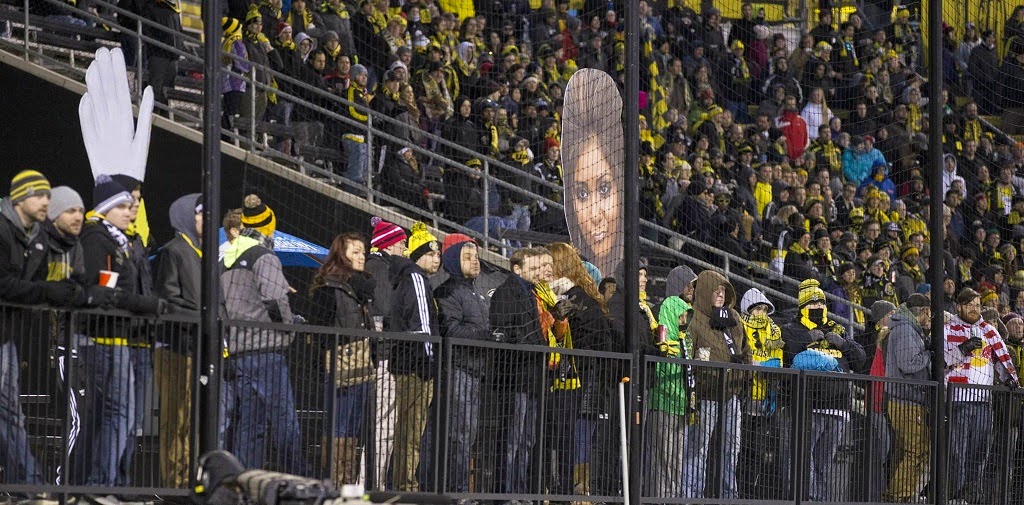
Some nice tifo from the first couple of weeks of the season
 |
| New York City home opener |
 |
| San Jose home opener and new stadium |
Saturday, November 22, 2014


Thursday, September 4, 2014

Thursday, July 3, 2014

Sunday, May 18, 2014

Subscribe to:
Posts (Atom)