Showing posts with label american soccer wars. Show all posts

Saturday, March 22, 2025

Uh oh..... part 2 - Promotion Relegation is coming to soccer in the USA


MLS is so screwed, and I am so happy. 

USL just made it official, promotion/relegation is going to happen. Look for it in 2027 or 2028, but it is now going to be a reality and with it MLS just became a lower level league.

They are going to have to do something, MLS is going to have to change. If they don't all the excitement in US soccer will be with USL.

This is going to get good and I am going to be watching much more closely. I want to see Garber and MLS get uncomfortable, and uncomfortable they will be. 

This is delicious.

(btw, YouTube is blowing up with videos about this. Eric Wynalda has done a couple, and a lot of other "soccer guy" that I have no idea who they are because I haven't followed soccer closely at all. But if you want go to YouTube and search and enjoy the show.)

Thursday, February 27, 2025

Uh oh.... "USL announces plans to start new league that would rival MLS"

My take.... I love this! 

MLS basically ruined my love for soccer. The way it is set up, they way it does business, Garber, etc.

MLS just became a monster, sullied by greed and corporate money.

Is USL any different? I don't know, I have never really followed them much. But with the chance of promotion and relegation in the future, the USA might just get a [english accent] proper football league [/english accent].

I will be watching this closely, and who knows, I might just come back to soccer.

-----

(espn.com 2-13-25)

The United Soccer League confirmed plans to launch a Division One men's professional league in 2027 rivaling Major League Soccer and defined by the sanctioning standards of the U.S. Soccer Federation, the USL announced on Thursday.

USL would operate completely separately from MLS, despite working under the same sanctioning by U.S. Soccer as a professional soccer league.

"Today is a defining moment for the USL and the future of soccer in the United States," said Alec Papadakis, CEO of the United Soccer League.

"Creating a Division One league is a bold step forward, expanding access to top-tier competition, deepening the connection between our communities and taking another step in aligning with the structure of the global game. By uniting people through soccer and bringing Division One to more cities, we're not just growing the sport-we're creating lasting opportunities while building a more sustainable and vibrant soccer ecosystem in the U.S."

The new Division One league stands as the highest of three levels for the USL, that includes USL Championship (Division Two) and USL League One (Division Three) to redefine a new system to progress development and talent.

In a statement released later on Thursday, U.S. Soccer said: "The continued investment into the game reflects the strength of the United States as a soccer country, which will only accelerate as we build towards hosting the 2025 FIFA Club World Cup and the 2026 FIFA World Cup. We welcome innovation and growth to the landscape of American soccer and we look forward to learning more."

The new tiered system would foster a promotion and relegation style in the long run, a feature that MLS does not employ.

"The USL has long been committed to creating a structure that drives growth, opportunity, and long-term success in American soccer," Papadakis said.

"The USL model empowers clubs with greater autonomy and fosters a dynamic, interconnected system-one that allows them to compete at the highest level while remaining deeply rooted in their communities. Around the world, top-tier clubs thrive in cities of all sizes, and we believe the same is possible here. The demand and infrastructure are in place, and the potential for growth is immense."

USL launched in 1986 with the idea to foster a youth-to-professional pathway for both men and women under one system across communities nationwide.

The organization previously launched a women's pathway that includes the top-tier USL Super League (Division I), which debuted in 2024, and USL W League, the country's leading pre-professional women's league, according to a news release from USL.

USL states the 2026 FIFA World Cup and 2028 Summer Olympics generated interest in the sport and high participation rates, inspiring the further development of the league.

https://www.espn.com/soccer/story/_/id/43827636/usl-announces-plans-new-league-rival-mls


Tuesday, November 7, 2017

NASL Hopes for Different Interpretation in Appeal of U.S. Soccer Lawsuit Ruling

(by Michael McCann si.com 11-7-17)

The survivability of the NASL hangs in the balance of a court familiar to many American sports fans: the U.S. Court of Appeals for the Second Circuit. This is the same federal appeals court that ruled against New England Patriots quarterback Tom Brady. It’s also the same court that will hear arguments brought by Dallas Cowboys running back Ezekiel Elliott in his case against the NFL.

For NASL and the U.S. Soccer Federation, the Second Circuit is critical for a different case. NASL has petitioned it to review whether U.S. District Court Judge Margo Brodie wrongly denied NASL’s petition for a preliminary injunction.
 
Brady, Elliott and the NASL share something else in common: they have placed their trust in the same attorney, Jeffrey Kessler. In advocating for NASL, Kessler insists that U.S. Soccer and its alleged co-conspirators (Major League Soccer, Soccer United Marketing and United Soccer League) have violated federal antitrust law. They have done so, Kessler charges, by blocking NASL from competing with MLS as a so-called “Division I” or top-level pro soccer league and by attempting to push NASL out of “Division II” so that Division II can be occupied alone by USL.
 
Put more bluntly, Kessler maintains that U.S. Soccer has unlawfully sought to destroy NASL. Absent judicial intervention, it is quite possible that NASL will go out of business.

To delay such an adverse consequence, NASL wants a federal court to enjoin (block) U.S. Soccer from reclassifying NASL during the duration of this litigation. The litigation could last years, meaning an injunction would be a game-changer for NASL.

Injunctions are very difficult to obtain and petitions for them are often denied. NASL had to convince Judge Brodie of four elements: (1) it would suffer irreparable harm without an injunction; (2) it has a likelihood of success on the merits of the legal arguments; (3) the balance of hardships tips in NASL’s favor; and (4) an injunction for NASL would be in the public’s interest.

As SI's Brian Straus explained, Judge Brodie found three of those elements to be in place. In fact, Judge Brodie expressly agreed with NASL’s assertion that the league faces a “likely total loss of its business” in the absence of an injunction. She also highlighted how NASL stands to lose interest from prospective investors who are exploring the possibility of bidding for as many as six potential new NASL teams in 2018.

Unfortunately for NASL, Judge Brodie found one element—likelihood of success on the merits—missing. Stated differently, while Judge Brodie was convinced that NASL is harmed by U.S. Soccer’s actions, she wasn’t convinced that U.S. Soccer is breaking the law in inflicting such harm.
 
To that end, Judge Brodie wrote that NASL “fails to demonstrate unreasonable restraint of trade.”
 
The judge took notice of how U.S. Soccer’s standards for classifying professional soccer leagues are arguably designed to promote quality of professional soccer in the U.S. and Canada. Further, Judge Brodie stressed that U.S. Soccer’s Board of Directors are required to act in the best interest of their accompanying non-profit, membership organization—U.S. Soccer—rather than any pro soccer league. “[M]embers of the Board,” Judge Brodie asserted, “may not blindly benefit MLS to the detriment of NASL or other professional leagues.”
 
Judge Brodie also appeared swayed by how certain business restrictions imposed by U.S. Soccer can advance the quality of soccer—even though, NASL charges, such restrictions might put NASL out of business and even though MLS and USL have periodically received exemptions from complying with those same restrictions.

For instance, U.S. Soccer stipulates that membership in Division I is contingent upon, among other things, featuring a minimum number of teams as well as a group of teams that play in three different time zones and in stadia with at least 15,000 seating capacity. These restrictions, U.S. Soccer contends, are critical for the success of pro soccer. If there are too few teams, for example, there will be “repetitive matchups” and fans will be inclined to tune out. National broadcasters also prefer that teams be dispersed across time zones and placed in larger markets.

NASL insists, correctly, that U.S. Soccer has it has not always held MLS to these restrictions. U.S. Soccer responds by noting that MLS requested different types of restriction waivers than those sought by NASL. As to USL’s compliance with other restrictions, U.S. Soccer emphasizes that the Division II league showed improvement in attempting to comply with restrictions whereas, from U.S. Soccer’s view, NASL did not.

Breaking Down the Appeal

Kessler hopes a yet-to-be-named panel of three judges on the Second Circuit construes the law differently than Judge Brodie. The judges will review the key legal issues “de novo,” meaning as new and without an obligation to defer to Judge Brodie. This non-deferential standard of review helps Kessler and NASL, although it by no means assures victory.

In fact, Judge Brodie is seldom reversed on appeal. According to Westlaw’s Judicial Reversal Report, 23 of Judge Brodie’s rulings have been appealed to the Second Circuit and only four of them were remanded or vacated; 19 (83%) were upheld. U.S. Soccer likely gains confidence from such data.

Kessler charges that Judge Brodie made fundamental legal errors. First, he contends that Judge Brodie applied a far too scrutinizing standard in assessing whether NASL has a likelihood of success on the merits. Judge Brodie treated the motion for a preliminary injunction as one for a mandatory injunction. The latter seeks to alter the status quo and requires a more conclusive showing than an ordinary preliminary injunction.
 
In her opinion, Judge Brodie noted that U.S. Soccer has rejected a request by NASL, which currently holds Division II sanctioning, to play under that distinction for the 2018 season. From that logic, the judge reasons, an injunction would alter the status quo, as NASL has already been rejected. Kessler ardently disagrees, stressing that NASL only wants to preserve the status quo and remain a Division II league. As a result, how the Second Circuit interprets “status quo” will play a pivotal role in NASL’s appeal.

Kessler also insists that Judge Brodie failed to properly infer wrongful behavior by U.S. Soccer’s Board of Directors, which Kessler portrays as inherently conflicted. He does so by stressing ties between the board’s members and MLS.

NASL’s petition is for expedited hearings to hear what it regards as an “emergency motion.” In the coming days, the Second Circuit will likely indicate a schedule for the appeal. In the meantime, the league's championship match, between the San Francisco Deltas and New York Cosmos, is set for Sunday. If NASL has its way, it won't be the last one.

-------------------

https://www.si.com/soccer/2017/11/07/nasl-appeal-us-soccer-lawsuit-ruling-injunction-kessler

Saturday, November 4, 2017

Judge denies NASL/s request for injunction to regain Division II status

(by Jeff Carlisle espnfc.com 11-4-17)

A federal judge has denied the North American Soccer League's request for a mandatory injunction against the U.S. Soccer Federation to regain its Division II designation.

The decision comes as a massive blow to the NASL, and puts its continued existence into doubt.

Judge Margo K. Brodie heard arguments this week from both sides in U.S. District Court for the Eastern District of New York. The NASL argued that it would endure "irreparable harm" by not regaining its Division II designation, in that it would effectively be put out of business.

The NASL also alleged that the USSF is engaged in a conspiracy, along with MLS, Soccer United Marketing -- the league's marketing arm -- and the second-tier USL, and that the USSF applied and changed the Professional League Standards -- which spell out the criteria for Division I, II, and III designation -- to harm the NASL.

But in her ruling, Brodie said that the NASL had not shown they were entitled to relief or proven a conspiracy.

"Although the Court finds that Plaintiff has shown irreparable harm, that the balance of hardships tips in its favor, and that an injunction would not harm the public interest, because as set forth below, the Court finds that Plaintiff has not made a clear showing of entitlement to relief, the Court denies Plaintiff's motion for a preliminary injunction," the ruling said.

The NASL issued a statement after the ruling saying it would appeal the decision.

"We are very disappointed with the Court's decision in denying our motion for a preliminary injunction," the league said."We remain steadfast in our pursuit of antitrust claims against the U.S. Soccer Federation and are confident that justice will ultimately be served.

"In light of the extreme harm this decision poses to the NASL and our teams, players, coaches and fans, we will immediately begin reviewing all of our legal options including the process for appealing today's ruling."

An application by the NASL to be given Division II status for the 2018 season was rejected by the USSF in September on the grounds that the NASL didn't meet the Professional League Standards (PLS) for Division II as laid out by the USSF. These included the having a minimum number of teams, and having teams in three different time zones in the continental U.S.

The NASL responded by filing an anti-trust lawsuit several weeks later and sought the injunction to regain its Division II status while the suit was litigated.

Brodie ruled the NASL was seeking a mandatory injunction because it intended to "alter rather than maintain the status quo" and that "Plaintiff's request is more analogous to a request for reinstatement of previously terminated benefits."

The judge said the NASL failed to prove there was an actual conspiracy among members of the USSF Board of Directors, who voted on various changes to the league standards.

"A plaintiff must prove that the common scheme designed by the conspirators 'constituted an unreasonable restraint of trade either per se or under the rule of reason.' At the very least, Plaintiff must provide evidence that there was an agreement to agree to vote a particular way, compromising each individual Board member's independence.

"While there is ample evidence of a conflict of interest between Defendant and MLS, Plaintiff fails to present sufficient evidence of undue influence in the actual standard-setting process, i.e., the process pursuant to which the PLS is revised."

Brodie also said the USSF's application of the league standards didn't amount to an "unreasonable restraint of trade," as laid out by the Sherman Antitrust Act.

U.S. Soccer's Statement re: Court's Decision on NASL Preliminary Injunction:

For U.S. Soccer, the ruling reaffirmed the federation's authority to regulate the sport in the U.S., which would have been put in doubt had the NASL received its injunction.

The USSF said its "responsibility is to ensure the long-term stability and sustainability of all professional leagues operating in the United States, as well as the teams that compete within those leagues," adding that the decision to revoke the NASL's Division II status "was made in the best interest of soccer in the United States.

"Today's decision confirms it was the correct decision," a statement said. "U.S. Soccer is committed to finding ways to improve the long-term viability of all leagues and teams and, by doing so, continue building upon the growth of soccer in the United States. U.S. Soccer is committed to working with NASL as it considers its future."

The NASL had hoped to obtain the injunction so that it could be classified as a Division II league while its antitrust lawsuit against the USSF continued. The Division II designation was also necessary to bring six expansion teams on board for next season.

The NASL, which is playing with eight teams this season, said the six prospective teams would not join the league if it played under the Division III designation next season.

The USSF had questioned whether the NASL really had six viable teams ready to go for 2018, and pointed out that one current team, North Carolina FC, is set to join the USL, while claiming another, the San Francisco Deltas, will fold after this season. The Deltas' future has not been confirmed.

The options for the current NASL teams include having the NASL reapply as a Division III league, or they could opt to join the USL. With the Division II status still being denied for the NASL, sources confirmed that the penalty for leaving the NASL is $100,000 as opposed to several million.

Sources also confirmed that multiple teams have reached out to the nascent National Independent Soccer Association, a Division III league set to being play in 2018.

Now the future of the league looks tenuous at best, though one league source cautioned, "I don't know what is next."

New York Cosmos owner Rocco Commisso has long stated he has no interest in operating in a Division II league. But the lawsuit look poised to go on.

----------------------

http://www.espnfc.us/north-american-soccer-league/story/3258359/judge-denies-nasls-request-for-injunction-to-regain-division-ii-status

Court Denies NASL's Request for Injunction in Lawsuit vs. U.S. Soccer

(by Brian Straus si.com 11-3-17)
 
The NASL’s request for a mandatory injunction restoring its second-division status for the 2018 season has been denied by a U.S. District Court judge, leaving the short and long-term future of the league in peril.
 
Judge Margo Brodie ruled Saturday morning that although the NASL did clear several required legal hurdles, including that the loss of D2 status would constitute “irreparable harm,” it ultimately never “made a clear showing of entitlement to relief.” The league was unable to demonstrate that the U.S. Soccer Federation (the defendant) isn’t entitled to regulate and determine professional division designations, while Brodie found that the USSF “has provided plausible bases to conclude that [division standards] have procompetitive effects.”
 
Perhaps more importantly, Brodie ruled that the NASL “fails to present sufficient evidence of undue influence in the actual standard-setting process” despite “ample evidence of a conflict of interest between [the USSF] and MLS.” Those aren’t uncommon in membership associations, she wrote, and in this case they’re “guarded against by [the USSF’s] fiduciary duties to its members.”
 
Brodie ruled, “Given these safeguards, even if so motivated, members of the [USSF] Board and the Standard Task Force may not blindly benefit MLS to the detriment of NASL or other professional leagues. Because Plaintiff’s claims rely so heavily on Defendant’s alleged financial motives, the Court’s conclusion on this factor also undercuts somewhat the other proffered evidence.”
 
U.S. Soccer’s decision to grant waivers to the NASL in the past, and the board’s vote to award provisional D2 sanctioning despite a contrary recommendation from the federation’s pro task force, also are among the elements that led Brodie to conclude, “that Plaintiff has failed to establish a likelihood of success on the merits, let alone a ‘clear showing’ of entitlement to relief.”
 
She added, “Even assuming, however, that Plaintiff has sufficiently demonstrated that there is concerted action … Plaintiff nevertheless fails to demonstrate unreasonable restraint of trade.”
 
Overall, the standards the NASL was forced to meet to win a mandatory injunction, which would effectively strip USSF of its regulatory power and reverse the status quo for 2018, proved to be too high. The NASL still could press forward with its antitrust case, which could continue even if the league dissolves. It also could appeal Brodie’s ruling to the Second Circuit Court of Appeals.
 
The NASL released the following statement shortly after the ruling came down:
 
“We are very disappointed with the Court's decision in denying our motion for a preliminary injunction. We remain steadfast in our pursuit of antitrust claims against the U.S. Soccer Federation and are confident that justice will ultimately be served. In light of the extreme harm this decision poses to the NASL and our teams, players, coaches and fans, we will immediately begin reviewing all of our legal options including the process for appealing today's ruling.”
 
U.S. Soccer then said the following:
 
“U.S. Soccer’s responsibility is to ensure the long-term stability and sustainability of all professional leagues operating in the United States, as well as the teams that compete within those leagues. After providing numerous opportunities over the years for the NASL to meet the Professional League Standards, or at least provide a pathway to meet those standards, the elected and independent members of the U.S. Soccer Board of Directors ultimately made a decision not to sanction the NASL as a Division 2 league. The decision was made in the best interest of soccer in the United States, and today’s decision confirms it was the correct decision. U.S. Soccer is committed to finding ways to improve the long-term viability of all leagues and teams and, by doing so, continue building upon the growth of soccer in the United States. U.S. Soccer is committed to working with NASL as it considers its future.”
 
The NASL semifinals are scheduled for Sunday evening.
 
Meanwhile, it will be worth noting the impact of U.S. Soccer’s victory on embattled federation president Sunil Gulati and the upcoming election that seems to be attracting additional candidates almost daily. Gulati has been under immense pressure since last month’s failure to qualify for the 2018 World Cup, and the potential consequences and bad PR associated with the NASL lawsuit weren’t helping. Sources tell SI.com that Gulati still hasn’t decided whether to run for a fourth term and that he was disappointed when his former right-hand man, USSF VP Carlos Cordeiro, announced his candidacy this week.

Now Gulati has a piece of good news. It’s uncertain whether it’ll embolden him, or do anything to mollify a frustrated board. Rumors of an emergency meeting to evaluate Gulati’s position have been circulating for more than a week and on Thursday, New York-based Front Row Soccer confirmed that eight board members requested a meeting in order to “discuss the history of hiring of U.S. national team coaches.” That history, of course, has been written by Gulati.

SI.com understands that USSF CEO Dan Flynn contacted the board and asked to push the meeting back to early December, around the date of the MLS Cup final. Most, if not all, board members agreed. The information, answers or context they want from Gulati apparently can wait until then, and it’s quite possible the tone will soften a bit thanks to Saturday’s ruling.

---------------------

https://www.si.com/soccer/2017/11/03/nasl-us-soccer-court-ruling-injunction-division-2

Wednesday, November 1, 2017

NASL vs USSF October 31, 2017 Hearing Notes

(by Chris Kivlehan midfieldpress.com 10-31-17)

First, a note about the notes:  This is not a transcript, but a narrative of the proceedings based on notes taken during the hearing.  It does not include every word that was uttered in the courtroom. I am not a stenographer. These are my notes on what I felt were the main important points of interest to Midfield Press readers.  If you want the transcript, by all means go get that when it comes out. I am providing my notes because many people have asked if specific issues were brought up in the hearing.  They also provide greater context for some of the snippets that have been out there on Twitter.  I have attempted to refrain from putting any commentary or analysis into these notes, and will do a separate article on that.  Hopefully that restraint will make the notes useful regardless of the reader’s personal leanings on the issues in NASL vs USSF.

****

Judge Margo Brodie presided over a hearing for an injunction requested by the North American Soccer League (NASL) that will allow it to move forward with its plans to compete in 2018 as a Division II league.  Jeffrey Kessler spoke on behalf of the NASL’s legal team, while Russel Sauer and Chris Yates spoke on behalf of United States Soccer Federation (USSF).

Anyone reading these notes should understand that Judge Brodie is not an expert on soccer, but has familiarized herself with the pertinent issues.  She demonstrated a strong understanding of the necessary issues, and kept lawyers on both sides on point, while giving them plenty of time to making their cases.  She projected an image of being thoughtful, respectful and fair.

****

Judge Brodie starts off by saying that the court has determined the request is a mandatory injunction.  This is a higher bar than the preliminary injunction that NASL sought.  She then goes on to explain where she is with her thinking, inviting counsel on both sides to change her mind with their arguments.

The Judge states that she feels the NASL has made a showing that it will suffer irreparable harm if it is not granted the injunction.  Judge Brodie also states she felt the balance of hardship tilted in the NASL’s favor.

She agrees with the NASL that the relevant market in question is top tier and second tier pro soccer leagues.  She believes that USSF has market power in that area.

She believes the USSF has shown sufficient pro-competitive reasons for the Professional League Standards (PLS).  She questioned if NASL could have used “less restrictive means to achieve its goals.”  She says she needs to understand why there is a conspiracy, but acknowledged that there is “definitely some smoke there.”  

Kessler states that the NASL has letters of intent from six additional teams that will only join if Division II status is maintained.  Kessler says that the United Soccer League’s (USL) survival at D3 is not relevant to NASL due to USL’s support from Major League Soccer (MLS) and MLS cash infusions into certain USL teams.

Judge Brodie asks why they don’t apply for Division II status with the new teams.

Kessler addresses irreparable harm by saying is extreme.  NASL will be put out of business without the injunction.  On the balance of hardships, Kessler argues that USSF had NASL as a D2 league for seven years.  NASL is asking that it maintain the status quo.  USSF have not shown this would cause them any harm.  USSF’s position is they want to be the rule-making body.

Judge Brodie takes issue with Kessler’s characterization of the balance of hardships being by far in NASL’s favor.  She says it barely tips in NASL’s favor, and says that the status quo is that NASL is not Division II for 2018.  She points out that USSF has authority from FIFA and that the NASL has been complying with USSF’s rules.  She states that she does not think it is her position to say they cannot regulate soccer.

Kessler counters that he does not think USSF has the right.  He points out that their standards must comply with antitrust laws.  He suggests that no other FIFA affiliated federation in the world has standards like USSF’s PLS.  

Judge Brodie suggests that is because soccer in those other countries is the number one sport, which is not the case here in the United States.

Kessler calls the PLS an unreasonable restraint on trade.  He claims that USSF is trying to prevent a free rider effect on MLS because competition is scary.  He says USSF is a private group making that decision.

Judge Brodie asked if Kessler is suggesting that the USSF cannot implement standards.

Kessler responds that these particular standards restrict entry into markets and that USSF are not offering a legitimate pro-competitive justification.  Their argument, according to Kessler, does not work.  USSF’s PLS usurp the will of the marketplace.  Kessler suggests it is up to consumers to decide what a viable league looks like.  USSF also increases the standards in an unfair way.

Kessler points out that the SUM Agreement, which is under seal, shows in order for USSF to make more money, MLS must make more money.

Judge Brodie questions what makes the conflicts of interest between MLS/SUM/USSF illegal.  She asks why is it not good enough that board members with an interest recuse themselves when making league standard decisions.

Kessler argues that USSF is broadly tied to MLS’s interest due to the SUM Agreement.  The only way certain financial targets of USSF can be hit is if MLS achieves certain financial targets per the SUM Agreement.

Kessler quoted Sunil Gulati saying that both USSF and MLS make more money when they are jointed tied together on a deal than they do separately. Kessler suggested that whether or not you think Gulati has good motives is irrelevant.  They are financially tied together, and you have to look at USSF’s actions through the lens of their financial interests.

Kessler argues that the PLS are arbitrary.  At one point 8 teams was good enough for MLS to have Division I status. Time zones are another example of an arbitrary PLS rule.

Kessler recaps his positions:
  1. The Professional League Standards constitute an agreement in the context of antitrust
  2. They are anti-competitive on their face as they block entry
  3. USSF violates trade association standards through their financial relationship with MLS. The SUM/MLS deal is a major source of USSF’s revenue, which impacts the interests of all board members.  Mr. Garber and Mr. Gulati can influence the other board members even if they recuse themselves from voting. The organizations are very tied together
  4. USSF has not met the burden of showing the PLS are pro-competitive. They cannot justify specific rules.  Kessler uses the time zone example, and says that one of the new NASL teams is in Detroit, which is in the Midwest region.  Why does it matter if it is in the Central Time Zone or not?
  5. The biggest less restrictive alternative is to let the marketplace decide.  Kessler points out that there are other countries in which soccer is not the number one sport, where rules like the PLS have not have promulgated.  He gives South Africa as an example.  Kessler feels the place of USSF is to make rules around issues like doping.  He argues that what makes competition are new entrants.  The PLS rig these barriers to entry in the way they apply and modify these rules

Russel Sauer now takes the microphone for USSF.

Kessler had made an example of a story of a 9 year old girl from San Francisco who became a Deltas fan and didn’t want to lose her team because of NASL’s sanctioning issues.  Sauer asked if they had shared with her that the San Francisco team was folding and not playing next year based on Rishi Sehgal’s statements in a meeting with USSF in September.

Sauer makes the point that self-inflicted harm is not irreparable harm.  He points out that NASL agreed to comply with US Soccer’s standards.  He further adds that NASL’s own operating agreement section 2.08 outlines their intent to operate as a Division II league.

Sauer rattles off years in which NASL did not comply with standards.  2014 is the only year I caught in which they were compliant.  Sauer asserts that the PLS have not changed on the issues that NASL did not comply with.  In its opportunity to comment on the 2014 standards, NASL did not complain about the number of teams or the time zone issue.

Judge Brodie challenges Sauer to ask why she should not rely on NASL owner affidavits that they league would suffer irreparable harm.

Sauer suggests that Rocco Commisso has no basis upon which to say Division III teams make less revenue.

Judge Brodie asks if Sauer is suggesting that a league operate without USSF’s sanctioning without consequence.  Sauer acknowledges there would be consequences to operating without sanctioning.

Sauer takes issue with the new teams that are said to be joining NASL, indicating it is the same old story from the NASL each year about new teams.  Sauer says, “The North Carolina team indicated it was leaving” and suggests that the new proposed teams cannot survive on their own.

Sauer introduces some data on USL and NASL revenues and costs.  He claims that USL Division III generated more ticket revenue on average.  There is an indication he is using information from only the independent USL teams, not the MLS2 teams.  Sauer claims that revenues are comparable between NASL in D2 and USL in D3, while costs are less and margins are better.

Judge Brodie asks for clarification that Sauer’s position is that because NASL could choose to operate as D3, their harm is self-inflicted.

Judge Brodie says a league that started as Division III moving up to Division II, and a league that started as Division II moving down to Division III are totally different situations.

The issue of waivers comes up and Sauer points out that USL has not been given any waivers for 2018 yet as it has not been sanctioned yet as Division II for 2018.  Sauer points out that all of USL’s waiver requests are team waivers, and that it has not asked for any league waivers.

Judge Brodie asks why it matters if it is a team waiver or a league waiver.  Sauer explains the difference from USSF’s point of view and Judge Brodie is satisfied she understands the nuance.

Sauer says that he can’t tell what the US soccer board will decide related to USL, but that USL demonstrated significant progress whereas NASL did not.

The issue of the Stevens Act comes up, and Sauer suggests that the Stevens Act does not limit USSF to regulating only amateur soccer.

Judge Brodie asks for clarification on whether Sauer is taking the position that Congress has given USSF the authority to regulate professional soccer.  Sauer clarifies that the Stevens Act does not limit their authority.  Sauer traces the USSF’s authority from the Olympic charter, from which FIFA draws its authority.  USSF is recognized by FIFA.  “Bottom line” is that USSF believes it has the authority to govern pro soccer and the Stevens Act does not limit it.

Sauer suggests that USSF will suffer a greater balance of hardship than the NASL because a ruling in favor of the injunction would delegitimize USSF’s ability to regulate soccer.  Therefore any league that does not like a decision will challenge it in court, according to Sauer.  He suggests that granting the injunction tells anyone they can fight a sanctioning decision in court.

At this point a 15 minute break is called.  

****

Some frustration is overheard from the NASL leadership observing that Stephen Malik, the owner of North Carolina FC who sat on the US soccer board, betrayed the NASL is his efforts to strengthen his position to land an MLS franchise.  It is also clear from the comments that certain NASL leaders such as Rocco Commisso are committed to seeing this legal action to the end regardless of whether the injunction ruling is in their favor.

****

After the break, Chris Yates from the USSF’s legal team takes the microphone.

Yates states that he believes they have debunked the NASL’s claim of conspiracy in their reply.  He states that any USSF conflicts of interest should be measured by the standards of New York corporate law, since USSF is a New York corporation.

Yates cites a case about the American Quarter Horse Association which deals with the need to establish conflict of interest beyond the financial interests of a few members.

Judge Brodie points out that the NASL is suggesting that non-voting board members can influence voting members, and alleges that MLS/SUM/USSF being tied together has given away USSF’s impartiality.

Yates claims that revenue from SUM is less than 20% of US Soccer’s overall revenue.  He suggests that USSF has completely proper governance consistent with US non-profit law.  It is pointed out that Sunil Gualti, Carlos Bocanega, Don Garber, Collins, and Steven Malik and recused themselves from voting on the NASL’s Division II sanctioning.  The vote was 9-1 against NASL, with John Paul Motta as the lone vote in favor of NASL.  Yates calls the NASL’s claim “dead on arrival.”

Yates suggests that “US soccer has been achieving its mission” of growing the game.  He points out that “the original NASL failed disastrously”, which is why the PLS are necessary and were implemented.  He suggests that the USSF is not alone in having standards, and the English FA regulates stadia size and the financials of owners “because they don’t want leagues to fail.”

Yates suggests that objective standards have been there for a long time, and that NASL not liking those standards does not mean it is a violation of the Sherman Act.

Kessler is on the microphone again.

Kessler cites the Allied Tube antitrust case as a precedent and says that USSF has not stated non-partisan as a regulating body.  Kessler suggests that the USSF is the only soccer governing body that has tied themselves financially to a competitor they intend to regulate.  He suggests that USSF forfeited their impartiality when they did this.

Judge Brodie asks why the PLS are not pro-competitive.

Kessler points out that the burden for USSF is to go beyond “because I say so.”  He suggests a line item justification.  He suggests the reason for the PLS is because competition is seen as risky, which is fundamentally not a pro-competitive stance.

Kessler points out that FIBA (basketball governing body) does not regulate professional basketball.  He uses the example of the ABA, which ultimately merged with the NBA in a free market environment.

Kessler takes issue with the USSF’s assertion that they have the balance of hardship because they will not get antitrust lawsuits from amateur leagues because the Stevens Act protects them on the issue of amateur soccer.

Kessler reminds Judge Brodie that all NASL seeks today is an injunction so they can continue with their plans for 2018 and with the lawsuit.

Kessler points out the curiosity that USSF has yet to make a decision on USL’s Division II sanctioning despite the 30 day extension for USL having passed by.  Kessler suggests this is intentional, aimed at improving the optics of this situation to the court.  

Kessler points out that the NASL is OK with USSF making rules about issues like doping, or how to handle concussions but not rules that restrict competition.

Kessler asserts that USL’s expenses are lower because they are paying players less and providing lower quality soccer.  He points out that there are two international players in the courtroom (David Ochieng and Lucky Mkosana) who would not join a team in a Division III league.  Kessler suggests that NASL has higher losses than USL because they are paying to provide a higher quality soccer product to eventually compete with MLS.

Kessler suggests that when NASL was denied Division I sanctioning when it applied in 2015, the basis was time zones and team waivers.  The result of this denial was that NASL lost teams to MLS and USL.  He points out that Malik of NCFC is joining USL because he wants to be in a Division II league.

Kessler suggests that this is not like the drug industry or a safety issue that USSF is regulating with the PLS.   He points out that USSF’s economic ties with MLS make them conflicted.

Kessler recaps his positions:
  • The PLS are an agreement/contract in the context of the antitrust issue, and NASL was forced to comply with them because without a FIFA sanction you cannot run a credible league
  • The situation is anti-competitive because USSF is favoring one party more.  They are not acting as an unbiased regulator.  NASL believes the effect USSF claims of the PLS is not pro-competitive.  They could have rules without requirements on numbers of markets and on time zones
Next steps:  The USSF will submit more documents tonight or tomorrow morning functioning as a response to the documents NASL submitted in its reply to USSF prior. NASL got a slap on the wrist from Judge Brodie at the beginning for that, and USSF similar pushed the envelope by referencing items they will introduce in the next document dump in their presentation. Kessler will have the opportunity to write the court a letter that the court will consider pointing out any inaccuracies in USSF’s submissions.

Judge Brodie stated that she will aim to make a decision on the injunction this week.

-------------------

http://midfieldpress.com/2017/10/31/nasl-vs-ussf-october-31-2017-hearing-notes/

Monday, October 30, 2017

SUM’s $5 Million Offer to Purchase New York Cosmos IP Comes to Light, Raises Questions

(by Steve Hamlin midfieldpress.com)

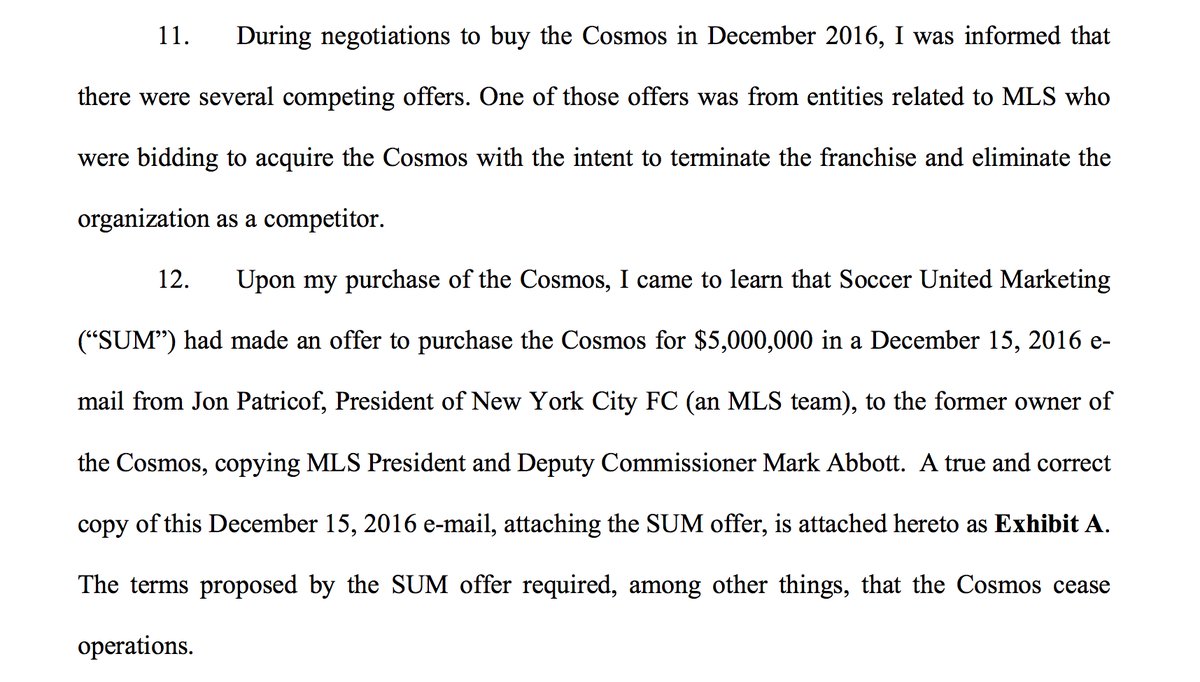
In the NASL’s most recent filing for injunctive relief against the United States Soccer Federation, current New York Cosmos owner Rocco Commisso claimed that Soccer United Marketing – a partnership between Major League Soccer and its regulatory body, USSF  – attempted to buy the club to “with the intent to terminate the franchise and eliminate the organization as a competitor.” Commisso’s allegation was first reported on by Brian Straus of Sports Illustrated. The full offer from SUM was later made public on Twitter by Miki Turner.


For the average fan, it’s a lot to digest, but there are a few big points worth noting. First, Soccer United Marketing would be acquiring all of the assets listed, not sending them to the U.S. Soccer Hall of Fame. This is an essential distinction as negotiations during the 2016 off-season stated that the USL’s term sheet to essentially absorb the NASL last offseason insisted that all NASL-related IP would be transferred to the Soccer Hall of Fame, and not kept by said clubs. Second, the agreement requires that New York Cosmos, LLC not operate a soccer team in the MSA for a period of 10 years following the agreement to “avoid consumer confusion in the marketplace”. Third, the agreement forbids New York Cosmos, LLC from publicly disclosing the sale of the intellectual property to SUM.

Additionally, it’s worth noting how wild the timing of the offer from SUM is. The morning of the e-mail sent from Jon Patricof, December 15th, Seamus O’Brien, then owner of the Cosmos, was set to accept an offer from GF Capital Management, a private equity firm, for $3.5 million. The offer would have shut down the brand and the team. The night before O’Brien, then owner of the Cosmos, was contacted by Commisso about possibly buying the team. The two men would meet for 12 hours on the 15th, eventually reaching a deal for the club.

Commisso has alleged that SUM intended to eliminate the Cosmos as a competitor and called this a move to kill the club. While the agreement certainly would have killed New York Cosmos, LLC and the club’s participation in the North American Soccer League, the intentions become more muddied upon further inspection. What would Soccer United Marketing do with the Cosmos intellectual property and no team behind it? Further, why was the intellectual property worth $5 million?

It may be helpful to first look at what Soccer United Marketing actually does, outside of broadcasting deals. SUM currently offers partnerships, but the “authentication” arm of SUM seems to be a bit more interesting. Soccer United Marketing offers “to authenticate your products with the Official Marks of Major League Soccer, The United States Soccer Federation, The Mexican National Team and other top clubs in the world”, as well as “allow fans to show the depths of their passion and loyalty through the products they purchase every day.” Further, the email was sent by NYCFC President Jon Patricof and copied to MLS Deputy Commissioner Mark Abbott. Abbott, who also is MLS’s President, “leads a new business development group to address new areas of opportunity for the League and Soccer United Marketing” according to MLSSoccer.com.

This raises the question of whether Soccer United Marketing and Mark Abbott are primarily focused upon the business of fostering and growing intellectual properties rather than the sport itself.  This creates the possibility that SUM would purchase the Cosmos IP and use it for a rebrand of NYCFC, merchandise, or other marketing opportunities instead of fielding a unique team. With the head of MLS and SUM, Don Garber, stating numerous times (either genuinely or out of respect) that the Cosmos were a great brand, it would make financial sense to bring the Cosmos brand into the marketing umbrellas. This again raises the questions of why MLS and the SUM partnership seemed to find more value ($5 million, to be exact) having the brand and IP under their umbrella, than on the shelf of a private equity firm.

While there is nothing illegal or conspiratorial about approaching a brand on life support about a possible purchase, the SUM offer may prove to be one of the most controversial filings to come out of the NASL’s case against USSF.

The NASL’s motion for a preliminary injunction will be heard in civil court on October 31st in Brooklyn.

------------------------

http://midfieldpress.com/2017/10/24/sums-5-million-offer-to-purchase-new-york-cosmos-ip-comes-to-light-raises-questions/

Tuesday, October 24, 2017

NASL contends SUM tried to 'terminate' New York Cosmos

(by Jeff Carlisle espnfc.com 10-24-17)

The marketing arm of Major League Soccer made a bid to buy the North American Soccer League's New York Cosmos for $5 million with an aim to "terminate the franchise," new club owner Rocco Commisso has disclosed in legal documents.

The NASL's latest response in its ongoing antitrust lawsuit against the U.S. Soccer Federation included a declaration from Commisso in which he disclosed that as he pursued ownership of the Cosmos -- an organization that had laid off staff and stopped paying players, and whose sale was critical to the NASL's survival -- he became aware of a competing offer from Soccer United Marketing (SUM), the marketing arm of MLS and an entity that has a substantial business dealings with the USSF.

In an email from New York City FC president Jon Patricof dated Dec. 15, 2016, with MLS deputy commissioner Mark Abbott included, SUM offered to buy the Cosmos' remaining assets for $5 million.

Among the terms of the offer was that the new owners of the Cosmos wouldn't operate a soccer team in the New York Metropolitan area for a period of 10 years. Commisso stated that offer was made with "the intent to terminate the franchise and eliminate the organization as a competitor."

Commisso's rival offer was eventually accepted, and he completed his purchase of the team in early January. But the existence of the offer from SUM, and any intention to shut the Cosmos down, will likely be used by the NASL to buttress its claim that that MLS, SUM, and the USSF were engaged in a conspiracy to put it out of business.

The NASL's original complaint alleges that the USSF has violated federal antitrust laws through its anti-competitive "Division" structure that divides men's professional soccer for U.S.-based leagues based on what an NASL press release described as "arbitrary criteria that the USSF has manipulated to favor Major League Soccer (MLS), which is the commercial business partner of the USSF."

The division structure is intended to provide a set of minimum requirements for a league, including number of teams, geographic distribution of teams, market size of a team's city and stadium capacity, as well as the minimum financial requirements for team owners.

The complaint alleges that the USSF has selectively applied and waived its divisional criteria to suppress competition from the NASL and benefit MLS and the United Soccer League (USL).

The USSF granted the NASL provisional Division 2 status earlier this year. But in September, the USSF announced it had denied the NASL's application to be sanctioned as a Division 2 league, due to the fact that it could not guarantee it would field at least eight teams in 2018.

Commisso's declaration also details the NASL's expansion plans, which are intended to meet the USSF's Division 2 standards of having at least 12 teams. The plans entail adding six teams for 2018. This is in addition to the teams in San Diego and Orange County that already have been announced. It then plans to add two more squads for 2019, as well as an undisclosed number of additional teams by 2020.

The names of the cities involved were redacted, but previous court documents, including a 78-page declaration by USSF president Sunil Gulati, indicate that two of the cities in question are Detroit and Atlanta. Commisso indicated that all of the interest from the proposed expansion teams is contingent on the NASL retaining its Division 2 sanction.

On Oct. 16, the USSF filed a response of its own, including the aforementioned statement from Gulati, in which he disputed that the standards were intended to suppress competition, since they were formulated years before the NASL even existed.

Gulati expressed concern in August when he was told by NASL interim commissioner Rishi Sehgal that two teams -- Edmonton FC and the San Francisco Deltas -- had not committed to return, but that California teams in Orange County and San Diego would join the league. Gulati also expressed concern that North Carolina FC had not specified what league it would play in for 2018.

Gulati also contended that the numerous waivers the USSF had granted the NASL over the years undercut the league's argument that the USSF was trying to put it out of business.

"Given the large amount of turnover in the NASL since its founding and the lack of specific information provided, it was difficult to conclude that the NASL would have even 8 teams for 2018 -- the same number of teams as in 2017, still 4 teams short of the Division II minimum of 12 teams, and still with no team proposed for the Central time zone," said Gulati in his statement.

"In other words, at best the NASL had made no progress towards compliance with the Division II standards and, at worst, it had taken a significant step backwards by losing 2 or 3 teams while proposing 2 replacement teams with relatively little information."

At a Sept. 1 meeting between the USSF and the NASL board of directors, the NASL asked for three years to meet the Division II standards, but that offer was turned down.

In a declaration made by NASL interim commissioner Rishi Sehgal, he maintained that the USSF's decision not to grant Division I sanctioning in March 2016 thwarted the NASL's momentum, and that Gulati never informed the NASL that it had to be fully compliant with the Division II standards in order to receive that status for 2018.

Sehgal also contested Gulati's assertion that the USSF gave the NASL 30 days to appeal the decision to not grant Division II status.

Sehgal's statement read, "On September 1, 2017, in a suite at Red Bull Arena in Harrison, New Jersey, shortly before kickoff of the FIFA World Cup Qualifier between the United States and Costa Rica, Lydia Wahlke, General Counsel of USSF, informed me of USSF's decision to deny the NASL a Division II sanction for the 2018 season.

"I asked Ms. Wahlke if there was an opportunity to have further dialogue about that decision, and she informed me that there was no such opportunity but that the NASL would have the opportunity to have further dialogue regarding the ability to apply for a Division III sanction."

Sehgal concluded his statement by reiterating the NASL's argument that "irreparable harm" would be done to the league by virtue of losing its Division II sanction.

Arguments are scheduled to be heard before U.S. District Court Judge Margo K. Brodie on Oct. 31.

http://www.espnfc.us/north-american-soccer-league/story/3241322/nasl-contends-sum-tried-to-terminate-the-new-york-cosmos

--------------------------

NASL alleges SUM tried to buy New York Cosmos to eliminate club

(by Brian Strauss si.com 10-24-17)

As part of its effort to establish a pattern of anti-competitive behavior by the U.S. Soccer Federation, MLS and Soccer United Marketing, their $2 billion marketing arm, the NASL late Monday night alleged that SUM tried to buy the New York Cosmos last December “with the intent to terminate the franchise and eliminate the organization as a competitor.”
 
That claim was made in a filing by current Cosmos owner Rocco Commisso, a cable TV magnate who’s now helping to fund the NASL’s antitrust lawsuit against U.S. Soccer. The NASL is seeking an injunction that would prohibit the federation from stripping the league’s second-division sanction, thereby allowing it to operate next year. The injunction hearing is scheduled for Oct 31. at the U.S. District Court in Brooklyn. Commisso’s declaration was part of the NASL’s filing in advance of that hearing.
 
Commisso testified that SUM, a partnership between MLS and the USSF, offered $5 million for the Cosmos to former club chairman Seamus O’Brien. A term sheet, sent in an email from New York City FC president Jon Patricof, outlined the transfer of the Cosmos intellectual property and assets and indicated that, “To avoid consumer confusion in the marketplace, for a period of ten (10) years following the closing, New York Cosmos LLC and its owners shall not own or operate a soccer team in the New York metropolitan area under any name.”
 
The email was dated December 15, 2016. That morning, O’Brien reportedly was ready to accept another offer for his club from GF Capital Management, a New York private equity firm. The Cosmos had lost some $30 million and already had furloughed players and staff. GFCM didn’t intend to field a team, but O'Brien still preferred its offer of approximately $3.5 million. SUM’s intentions are unclear, at least based on the Patricof email (it's also unclear why NYCFC's president was the point man). But O'Brien's reticence may be telling. Commisso contacted O'Brien through intermediaries on the night of the 14th and the next day, they met for more than 12 hours in order to close the deal and keep the Cosmos on the field.
 
Had the Cosmos gone under, the NASL almost certainly would’ve followed. Commisso’s arrival spurred remaining owners to keep the Jacksonville Armada afloat until Robert Palmer bought the club this summer, allowing the NASL to play the 2017 season with provisional D2 sanctioning.
 
That sanctioning was stripped for 2018 in September, however, prompting the lawsuit. The eight-team NASL also claimed in Monday’s filing that it has commitments from six new clubs to join next year and an additional two for 2019—as long as D2 sanctioning is maintained. The cities and ownership groups were redacted from the filing, but Detroit, Atlanta and New Orleans are thought to be among the potential expansion markets. Commisso, Palmer and Miami FC owner Riccardo Silva likely will help buttress those new teams in order to keep the league in business.
 
There doesn’t appear to be anything illegal about the SUM offer. O'Brien wanted out, and it's possible MLS or SUM could've revived the brand. But the NASL hopes to establish at next week’s hearing that there’s a pattern of behavior resulting from the partnership between MLS and the USSF that unfairly limits and inhibits competition. If that's enough to secure the injunction, the NASL can move forward with its 2018 season while waiting for more evidence to come to light during the case's discovery phase.
 
--------------------
 

Monday, October 16, 2017

Saturday, October 14, 2017

Answers to 5 Key Questions in NASL's Lawsuit vs. U.S. Soccer

(by Michael McCann si.com 9-25-17)

Last week the North American Soccer League took its gloves off and readied for a battle. The NASL filed an antitrust lawsuit against the U.S. Soccer Federation in the U.S. District Court for the Eastern District of New York, insisting that its survival hinges on this case.

NASL’s complaint invokes federal antitrust law to argue that USSF is breaking the law. To that end, NASL contends that USSF and three alleged co-conspirators—Major League Soccer, Soccer United Marketing and United Soccer League—have unlawfully prevented NASL from competing with MLS as a Division I pro soccer league. Further, NASL asserts, USSF has sought to illegally strip NASL of its placement as a Division II league. It has done so, NASL maintains, so that MLS's favored minor league, USL, can become the sole Division II league.

NASL demands a preliminary injunction that would block USSF from revoking NASL’s Division II status. It also requests a permanent injunction that would prevent USSF from classifying leagues by division.

NASL warns that unless it obtains these remedies it could be driven out of existence. In such a scenario, NASL asserts, soccer fans would be the real victims. Their choice in men’s professional soccer in the U.S. and Canada would be greatly diminished.
 
NASL claims that it is a victim of a “conspiracy.” Could you explain the legal significance of that assertion?
 
NASL raises two claims in its complaint. The first is under Section 1 of the Sherman Act and it concerns the so-called soccer “conspiracy” theorized by NASL.

Section 1 makes it illegal for competing businesses and other entities—including non-profit organizations like USSF—to conspire in ways that unreasonably harm economic competition. Such harm is normally shown through higher prices, fewer choices of a product or service or diminished quality in a given marketplace.

Here, NASL argues that USSF—a national governing body under FIFA—has taken steps with the help of its co-conspirators to damage competition across men’s professional soccer in the U.S. and Canada. NASL charges that USSF has effectively made it impossible for NASL to compete with MLS as a top-tier league. Also, NASL insists, USSF now seeks to bar NASL from competing with USL as a second-tier league. These arguments directly relate to competition. One less competing league, so the logic goes, means that the remaining league becomes a monopoly over a particular level of pro soccer. With that status, the remaining league—in this case MLS for Division I and USL for Division II—theoretically has fewer incentives to innovate. Likewise, the remaining league can charge consumers (fans) higher prices and pay labor (players) less.

In order to prevail, NASL will need to convince a court that its depiction of competition fits relevant markets. NASL’s complaint expends considerable energy distinguishing top tier/Division I soccer teams from second tier/Division II teams. Likewise, NASL insists that Division I and Division II are not substitutes for one another. For instance, NASL highlights the existence of higher-value sponsorships and more national associations for Division I teams than are typically found among Division II teams.

NASL also maintains that fans of professional soccer do not consider other pro sports leagues, such as the NFL and NBA, to be viable substitutes for Division I and Division II men’s professional soccer. Those leagues “have different rules of play” and appeal to fans with different kinds of interest.

NASL’s desire to describe top-tier and second-tier soccer as unique carries significance under antitrust law. NASL is more likely to prove that USSF is unlawfully harming competition if NASL can show that the relevant market for competition analysis is limited to these two soccer leagues. USSF, in contrast, will be poised to argue the relevant markets are less fixed and more dispersed. Along those lines, USSF will claim the relevant markets span across the sports and entertainment industries—and thus any USSF rules that limit competition in soccer are not especially impactful when considering the totality of sports and entertainment offerings for consumers.

Under the relevant standard, Rule of Reason, NASL will need to show that USSF’s rules harm competition more than they help it. With that in mind, expect USSF to argue that in the absence of USSF rules that limit competition, it would be difficult, if not impossible, to organize men’s pro soccer in economically beneficial ways. USSF could stress that soccer leagues across the world are designed as pyramid structures with multiple divisions—albeit with promotion and relegation, which does not exist in the U.S. and Canada. Further, given the volatility in professional soccer in the U.S. and Canada over the years, USSF may be able to persuade a court that its structure is essential to ensuring that U.S. soccer fans receive a reliable product and one in which sponsors will invest.

NASL also raises a monopoly claim. How strong is that claim?

NASL’s monopoly claim invokes Section 2 of the Sherman Act. Section 2 prohibits an entity from intentionally acting as an unlawful monopoly in a relevant market. Here, NASL charges that USSF has ensured that MLS enjoys monopoly status for Division I soccer in the U.S. and Canada. USSF has done so, NASL contends, by trying to destroy NASL and thus wipe out any competition. NASL also asserts that USSF desires to see USL become a monopoly of Division II soccer.

Whether NASL can prove its monopoly claim will depend on whether MLS and USL’s market positions reflect willful acquisitions of power rather than simply being good at what they do. In other words, if MLS has enjoyed full control over top tier men’s pro soccer because of its organizational strengths, then it would be more difficult for NASL to prove the existence of an illegal monopoly.

How does FIFA fit into this dispute?

NASL is a member of USSF and USSF is a member of FIFA. Statutes promulgated by FIFA require that “disputes affecting leagues, clubs, members of clubs, players officials” go first to arbitration before they can be heard in a court. FIFA uses the Court of Arbitration for Sport in Lausanne, Switzerland as a forum for arbitration matters.

Instead of seeking a remedy through arbitration, NASL has sought relief through a U.S. federal court. To be sure, USSF will argue that the court should dismiss NASL’s lawsuit as not yet “ripe”—meaning, NASL is contractually obligated to first try arbitration before seeking court intervention.

In response, expect NASL to contend that it should not be obligated to arbitrate matters that pose an immediate threat to its existence. If NASL were forced to arbitrate, it may not be able to obtain the kind of remedy it seeks—a preliminary injunction.

Why is NASL’s chief lawyer an important part of this controversy?

(more to come)

--------------------

https://www.si.com/soccer/2017/09/25/nasl-us-soccer-lawsuit-questions-fifa-kessler

Last-Gasp Meeting to Shape Future of NASL–and U.S. Soccer's Club Landscape

(by Brian Strauss si.com 9-14-17)

The U.S. Soccer board wasn’t convinced two weeks ago that the NASL had a viable plan to meet the standards established for second-division professional leagues. So this Friday in New York City, where the federation denied the NASL’s request for 2018 sanctioning in a September 1 vote, owners will gather and attempt to come up with one.
 
They’ll need to find a path they can go down together—and one that entices others to join them—before convincing the USSF to consider reversing its decision. The fate of the seven-year-old league hangs in the balance.
 
Multiple sources confirmed Friday’s meeting to SI.com and through conversations with executives connected to the NASL, USL and U.S. Soccer, a picture of the complex, sometimes controversial sanctioning process took shape. Most declined to speak on the record. An NASL spokesperson referred to a statement released last week, which read in part, “The NASL is disappointed with the [USSF] decision and does not believe that the federation acted in the best interest of the sport …. the NASL remains committed to growing the game and is exploring multiple options as it continues planning for the future.”
 
Launched in 2011 following a split in the league that became the USL, the NASL has been about ideology as well as soccer. It’s an eight-team circuit that advocates for self-determination and independent clubs and bristles at the stricter, more centralized structure of MLS and the USL (which are partners). There are those who feel the federation’s current standards, which were established in 2014 and dictate minimums league members must meet in order to achieve a specific sanctioning level, are part of the problem. Perhaps at this point in American soccer’s evolution, they’re arbitrary or even unnecessary, they argue.
 
Those arguments, however—the ideological ones—will have to wait for another day. In order to have them, the NASL must survive. And without second-tier sanctioning, it’s in serious trouble. Sponsors, TV partners and segments of the media and fan base do care about division designation, and owners believe it impacts their asset's value and appeal. Falling to D3—U.S. Soccer likely would be amenable to such an application—isn’t going to be a well-received option in the NASL board room. So, they have to find another way.
 
The USSF handled the sanctioning issue last winter by offering provisional D2 status for 2017 to both the NASL, which didn’t have enough teams (12), and the USL, which moved up from D3 but still has members that didn’t meet every piece of criteria (stadium/field size, coaching licenses). By August 15, each league had to submit its D2 plan for 2018—the federation didn’t want to leave teams scrambling again by waiting until the last minute.
 
The USL has 30 members currently and will comprise at least 33 next season. And there are instances (around 20 or 21 according to a source) where several clubs don’t meet every D2 standard. For example, the Charlotte Independence must expand their new facility in suburban Matthews, N.C., to hit the 5,000-seat minimum. But the issues appear to be manageable, and on September 1, U.S. Soccer gave the USL 30 days to provide a plan to resolve each waiver requested. At worst, a non-compliant club can drop to the third-division league USL plans to launch in 2019.
 
--------------------
 

NY Cosmos Chairman Rocco B. Commisso Reiterates Call for Immediate Resignation of USSF’s Sunil Gulati

(nycosmos.com 10-13-17)

Sunil Gulati’s role as a U.S. Soccer power broker has outlasted three U.S. Presidents.  During his reign as President of the Federation, the performance of the U.S. Men’s National Team has fallen to its lowest point in 30 years. The responsibility for the American men’s failure to qualify for the 2018 World Cup and the last two Olympic Games must land at Mr. Gulati’s feet. 
 
In a similar situation, the  French team's performance at the 2010 World Cup which was widely perceived as a “fiasco,” the President of the French Football Federation, Jean-Pierre Escalettes, not only accepted responsibility but also recognized that the failure created a “duty to resign from my role as President of the French Football Federation.” 
 
By refusing to definitively address his future plans, Mr. Gulati is putting self-preservation ahead of his duty to our Federation. His public acknowledgement of shared responsibility for the National Team’s disastrous failure to qualify is meaningless unless there is a personal consequence to him reflective of the seriousness of the debacle he presided over. Coach Arena took a harder, but much more honorable route.  Mr. Gulati should do what is necessary and appropriate:  resign.  Not only would that be the right thing to do, it would also allow new leadership to begin fixing the systemic problems that plague the beautiful game played and followed by tens of millions of Americans.
 
--------------------
 

Thursday, October 12, 2017

Antitrust lawsuit: NASL dug its own grave despite USSF-MLS collusion

(by Kartik Krishnaiyer worldsoccertalk.com 9-19-17)

What do investors in soccer do when they’ve made one bad business decision after another? And to make matters worse, when they’ve shifted from one rhetorical strategy to another? Sue their governing body, of course!

This is the path the North American Soccer League (NASL) has chosen to justify the league’s complete failure to create a stable and successful second division that works within the confines of US Soccer. After seven seasons as a sanctioned Division II league, NASL was informed on September 1, 2017 that they would not be approved as a D II league by the United States Soccer Federation (USSF) for 2018.

While the peculiar structure of soccer in the United States is something that should be reformed, NASL has fallen badly within a current system that they have willingly participated in and within which they have sought and received investment and protections in the marketplace. NASL’s goal to challenge first division MLS while perhaps noble was always doomed to failure whether or not the USSF put its thumbs on the scale or not. But it was perhaps unwise of the USSF to continue to overtly do business with MLS and its marketing arm, Soccer United Marketing (SUM), and allow SUM to negotiate TV and marketing deals on the USSF’s behalf that favor MLS. Regardless, NASL has dug its own grave and while an antitrust lawsuit against the USSF from another entity might have more standing, NASL is the wrong party to file such a suit as they have for seven years benefitted in one way or another from the USSF’s governance of the sport in this country.

The lawsuit filed on Tuesday alleges “that the USSF has selectively applied and waived its divisional criteria to suppress competition from the NASL, both against MLS and against United Soccer League (USL). For example, under the USSF’s divisional criteria, there are European clubs that have successfully operated for decades that would be considered ineligible for “Division I” or even “Division II” status due to arbitrary requirements like stadium capacity and market size.”

This is completely disingenuous. First, NASL has been granted Division II status for the last seven seasons and has required waivers in each of those seven years. These waivers have been granted by the USSF time and again and have included at various times, NASL not having the correct number of teams to be a sanctioned Division II league or enough US-based teams or being in the required three time zones with its US based teams. Second, European clubs are subjected to standards similar to the USSF’s divisional standards but ones that apply to those nations. For example, clubs in the English Championship and Premier League are required to have certain sized stadiums, and coaches are required to have UEFA Pro licenses.

The irony of all of this is that NASL had a strong hand in the crafting of the very D2 guidelines the league now falls short of meeting. USL could have filed a similar claim in 2010.

NASL’s leadership at the time worked closely with the USSF to craft D2 guidelines in 2010 that worked to displace USL who had been previously sanctioned as a Division 2 league from the early 2000’s until 2009. USL’s move was to consolidate its remaining clubs into a Division 3 league, working with new investors in previously underserved markets to recover its footing. In 2017, USL regained Division 2 status, albeit provisionally. As of this writing, USL per my sources remains under review from the USSF as to whether they will be granted Division 2 status for 2018.

The lawsuit filed by NASL claims that because USL has a business relationship with MLS and has accepted “minor league status” that the USSF is demonstrating favoritism toward USL. I wholeheartedly agree that MLS has been given favorable treatment by the USSF but would strongly argue USL has not and thus at least part of the NASL’s complaint is misguided. In fact, in January the USSF removed USL owner Alec Papadakis from its Board of Governors and replaced him with NASL owner Steve Malik of North Carolina FC.

A logical move for NASL would have been to do something similar to what USL did in 2010. Drop down to third division and patiently work to rebuild the league and eventually return to Division 2 status. But NASL’s current group of owners lack patience and perspective. Every NASL owner save one did not own a team in US professional ranks prior to 2014 and the league has often appeared to be in a race to get to Division 1 so they could retain the interest of the owners they have on board.
NASL dug its own grave by failing to properly vet new ownership and to aggressively move into markets like Cincinnati, Sacramento and others that lack an MLS team and were open for high-level professional soccer. NASL rhetorically at the time threw barbs at MLS when a far better strategy would have been to expand to markets that MLS would eventually want to grab and create a strong enough league framework to keep those markets in its league. But NASL lacked the patience and the discipline to carry this out and allowed USL to almost completely run the table of prospective strong markets without an MLS club.

Following those failures, the league began to get desperate and made several expansion errors. Out of NASL’s last five expansion teams, four have struggled mightily, changed owners or gone out of business entirely with Miami FC the only one that appears stable. The most recent expansion team, the San Francisco Deltas, has become somewhat of a running joke with the owner pleading for fans to bring friends to the matches among other things.

The San Francisco situation was, according to my sources, the final straw for many in the federation when it came to giving NASL chances. Last year at this time as NASL was battling to stay alive after the defection of the Tampa Bay Rowdies and Ottawa Fury FC to USL, NASL touted the new club in San Francisco as a star, a startup that would help redefine its league. Instead, the Deltas have become a noose around NASL’s neck.

The USSF and MLS should be held to account for its incestuous relationship and the continued favoritism with which this nation’s governing body provides MLS. But NASL is absolutely the wrong messenger in this fight and I personally believe US Soccer has to this point shown USL, the actual current rival of NASL, no favorable treatment. This having been stated, the USSF’s relationship with MLS creates a real problem from the standpoint of antitrust laws but the federation can easily argue, as I have above, that NASL has if anything been complicit in this peculiar and potentially illegal structure for the sport in this country.

--------------------

http://worldsoccertalk.com/2017/09/19/antitrust-lawsuit-nasl-dug-grave-despite-ussf-mls-collusion/

Statement from New York Cosmos Chairman - Rocco B. Commisso.

(nycosmos.com 10-11-17)

As a former college soccer player and youth coach, I know first-hand the flood of emotions that the U.S. Men’s National Team must be experiencing after last night’s loss to Trinidad and Tobago, which eliminated us from the 2018 FIFA World Cup. I understand the anguish and guilt felt by the players after letting down millions of fans of the national team, young and old. I respect the professionalism that it takes for the U.S. coach to step up and take responsibility without making excuses.
 
The real causes of last night’s debacle, however, weren’t actually present on the field or on the sidelines in Trinidad. Instead, the result was a byproduct of larger, systemic problems within the sport in our country. The blame must be placed squarely at the feet of U.S. Soccer’s management, led by Sunil Gulati. The first step in ensuring that American soccer consistently performs at a level that spares all of us the kind of negative emotions generated by our National Team’s failure to qualify for the World Cup is for Mr. Gulati to resign. It is his only honorable path forward. The USSF Board members and senior management personnel appointed or nominated by Mr. Gulati should follow him out the door.
 
While I’m disheartened by the result of the game, I’m not surprised. Going back to the first New York Cosmos Media Day after I assumed control of the club earlier this year, I have consistently expressed my dissatisfaction with the efforts put forth by the USSF. As a passionate soccer fan and team owner, I wish that the outcome against Trinidad and Tobago had proven me wrong. Regrettably, the team’s performance along the road to the World Cup in Russia did just the opposite.
 
When it comes to men’s soccer, the U.S. has never come close to achieving international prominence, as it should, given our country’s size, resources and huge pool of athletic talent. We produce the best baseball, basketball and football players in the world, but in the case of soccer the reverse is true. In the almost 12 years during which Sunil Gulati has been the USSF’s President, little or nothing has been done to enhance our prospects, despite the vast resources and power that he commands as chief executive of the sport’s governing body.
 
Frankly, the leadership of U.S. Soccer has failed all of its stakeholders: players, fans, sponsors and those of us who have invested in professional soccer. Getting back on track requires fundamental change in the structure and management of the sport in our country, starting with a change in the Federation’s leadership. I pledge my personal support and that of the NY Cosmos to the task of bringing about the necessary reforms.  
 
------------------
 

Sunday, December 18, 2016

Complications, uncertainty aplenty for future of NASL, Cosmos, USL entering key meetings

The tiers below MLS–and a number of the clubs that play in them–face future-altering decisions in the coming days.

(by Brian Straus si.com 12-3-16)

While the league at the top of the American (and Canadian) pro soccer pyramid, such as it is, focuses next week on crowning a champion, the battles beneath MLS finally may reach their conclusion.
                           
There have been multiple meetings comprising some combination of NASL owners, NASL and USL executives and U.S. Soccer Federation officials in recent weeks, aimed at addressing the volatility and uncertainty weighing on the sport’s second, third and fourth tiers. And there’s more to come Monday and Tuesday in New York. There, the NASL and its most famous member, the Cosmos, could find themselves on their last legs.
                           
The NASL, which sits one level beneath MLS, originally intended to compete with the older league on equal terms. But now it’s fighting for its survival. Pressure is coming from above and below. Minnesota United, one of the NASL’s most successful clubs, has joined MLS. Meanwhile, the third-division USL, which is affiliated with MLS, is expanding rapidly and will absorb two NASL clubs—the Tampa Bay Rowdies and Ottawa Fury. And if the USL has its way, the Rowdies and Fury will be second division again in 2017. The league has filed a formal application with U.S. Soccer to move up the pyramid.

Several sources have told SI.com that they expect that application to be approved.

Absent promotion and relegation, divisions are largely semantic. But those semantics have consequences. The labels can impact investment, sponsorship, budget and prestige. They also indicate the standards to which U.S. Soccer holds a given league. At the moment, the NASL’s original D1 ambitions have faded. The departure of Tampa Bay, Ottawa and Minnesota leaves it with 10 teams—at least in theory.

Rayo OKC isn’t expected to return. The Fort Lauderdale Strikers don’t have an owner and are the subject of a legal complaint filed by Rowdies owner Bill Edwards, who apparently helped keep his rival afloat. The Jacksonville Armada have financial concerns, according to sources. And the Cosmos, the NASL’s three-time champion and flagship club, may be on its way out of business. Tension is high as the NASL tries to attract expansion teams while several existing clubs hunt for investors or eye the exit.
                           
The USL, meanwhile, was at 29 clubs last season and will field at least 30 in 2017. It maintains that it’s already the de facto second division, even though it included 11 MLS-operated reserve teams, and it anticipates acquiring an official designation next week. But U.S. Soccer has no interest in creating a logjam of two leagues at the same tier, nor does it want to see its D2 league fold. NASL clubs considering a move to USL likely will have to pay to do so, and they must decide quickly whether to bet on the NASL’s survival or bolt for the USL and hope it’s raised to D2. A merger isn’t going to happen, and the USL reportedly rejected the NASL’s offer for interleague play. The USL has no interest or reason to alter its structure or ownership and wouldn’t be interested in absorbing every NASL club.

On Monday in New York, U.S. Soccer’s pro league task force will meet to review each circuit’s year-end reports and their requests for division sanctioning and waivers (not every team meets every standard). That task force is comprised of three USSF officials—chief administrative officer Brian Remedi, executive VP Carlos Cordeiro and U.S. Adult Soccer Association president John Motta. They’ll present a report to the full board of directors on Tuesday. USL and NASL officials will be in New York as well. U.S. Soccer could vote Tuesday to grant the NASL the waivers it needs to remain D2, thus maintaining the status quo. It could try to find a way to create one all-encompassing second division. Or it could “promote” the USL and “relegate” the NASL, which very well could result in the movement of some teams and the folding of others.

If one or more NASL teams shuts down or leaves before then, the league could collapse on its own.
The division standards, ironically, were enacted to prevent the sort of chaos that once was all too frequent in the USL and its predecessors. Fly-by-night teams would come and go, players and coaches dealt with sub-par operations and it was difficult to keep track of who was where. U.S. Soccer has wanted to tighten the standards over time, which the NASL objected to last year, and it’s believed the leagues are still operating under those set down in 2014.
A D2 league, for example, must start with a minimum of eight teams and have 12 by its sixth season. Next year will be the NASL’s seventh. Three-quarters of its teams must play in metro areas of at least 750,000 people and they all have to be in stadiums seating at least 5,000 fans. Each club’s principal owner must have a net worth of $20 million. Those standards are lower at the D3 level. U.S. Soccer has been auditing USL clubs this year to ensure they comply, and sources tell SI.com that the league is confident that meeting a sufficient number of D2 standards isn't an issue. But as long as the NASL occupies the second tier, the USL likely won't. There's no rule preventing two leagues at the same tier, but U.S. Soccer desperately wants to avoid that confusion.

NASL commissioner Bill Peterson has been trying to recruit expansion teams and at least four potential groups were present at the league’s meetings last week in Atlanta, according to sources. The NASL’s hope is that it can hang on at D2 long enough to bring new teams aboard in 2018. Los Angeles, San Diego, Detroit, Chicago, Atlanta and Hartford are among the cities with potential investors, according to sources. The Chicago effort is led by former Chicago Fire president Peter Wilt, who also helped launch NASL finalist Indy Eleven. Wilt also is working to recruit investors in other markets, according to a source.

Indy is one of the healthier NASL clubs. It had MLS ambitions several years ago but a couple of failed stadium efforts put those plans to rest for the time being. Its average attendance of 8,396 was second in the league behind Minnesota (the overall average was 4,734). Tampa Bay and Ottawa were third and fourth, respectively, meaning Indy is the only one of the league’s four most popular teams that might remain in 2017.
                           
Sources say the key to both leagues’ future may be in North Carolina, where the Cary-based Carolina RailHawks believe they are laying the groundwork for entry into MLS. The question is whether they’ll attempt to make the jump from the NASL, where they’ve spent the past six years, or the USL, where they played in 2007-09.

On Tuesday afternoon, presumably while the USSF board is meeting in New York City, the Railhawks will unveil a new name and logo, as well as their intention to finalize a stadium plan and secure an MLS expansion team within the next 12-18 months. The new name, North Carolina FC, and a standard shield logo were leaked early Friday by Raleigh writer Neil Morris.
                            
The RailHawks were purchased last year by local medical software entrepreneur Steve Malik. He once was a proponent of aggressive NASL expansion. But if MLS is his ultimate goal, moving to the affiliated USL might be the ticket. He’d have natural rivals in Richmond and Charlotte (another market with MLS ambitions) and a better spot for his reserve team, which currently competes in the fourth-tier, semi-pro NPSL. The NPSL has a relationship with the NASL while its chief competitor, the PDL, is owned by the USL. It just so happens that two of the Railhawks’ three Carolina-based NPSL rivals, the Myrtle Beach Mutiny and Tobacco Road FC (Durham), moved to the PDL last month.

If Carolina switches leagues, the remaining dominoes may fall. The Cosmos, despite their on-field success and the value of their brand, could fold soon if a new investor isn’t found. Most front-office employees are on furlough and according to Minnesota website FiftyFiveOne, the club has lost more than $30 million since joining the NASL in 2013. The Cosmos had intended to leave Hofstra University and play the 2017 season at MCU Park, a baseball stadium in Brooklyn. A few players and head coach Giovanni Saverese remain under contract. It’s almost impossible to imagine the NASL without the Cosmos, but it’s also difficult to foresee them playing anywhere else. The club's decision to rebuff MLS’s expansion invitation left lingering bitterness that may come back to bite the Cosmos if the USL proves to be the only safe harbor.
                           
Jacksonville is thought to be another candidate to move due to its financial situation. The number of USL teams and their focus on regional scheduling cuts costs. Those savings may be an inducement to FC Edmonton as well. The NASL’s only remaining Canadian club announced an extension for coach Colin Miller on Friday and co-owner Tom Fath told Canadian website The11 that, “The expectation is that we will play in the NASL in 2017.” Puerto Rico FC, which is owned by New York Knicks forward Carmelo Anthon, and Indy are expected to survive.

And that leaves Miami FC, the ambitious club owned by Italian media rights mogul Riccardo Silva. MLS’s pursuit of a Miami franchise owned by David Beckham could mean the USL won’t be interested in taking Silva aboard. But the USL and Silva have talked, according to a source. Miami FC spent the 2016 season at FIU Stadium, but it was unhappy with the field.

Another source said that Silva has spoken with Miami Dolphins owner Stephen Ross about possibly playing at Hard Rock Stadium (the latest/sixth name for the NFL facility). Ross helped launch the International Champions Cup, the summer friendly tournament that attracts big-name European teams to U.S. shores, and was linked to Beckham several years ago. Minor league soccer doesn’t appear to be Silva’s and Ross’s endgame. The NASL may not even maintain the eight teams required to qualify for D3 next year, although U.S. Soccer might still let it operate at that level for a season as it reorganizes. 
                           
Where Miami FC will play in 2017 is uncertain. Where several others will play is uncertain. What is certain is that a solution must be found soon. USL teams still haven’t started crafting their 2017 schedules, because they don’t know how many teams will wind up in the league. The league’s annual meeting is next week in Florida. NASL players aren’t sure if they need to look for new clubs. Front office personnel face upheaval as well. Everyone is waiting for someone else to make the next move, and it appears it may fall to U.S. Soccer's board to untangle the knot.

-------------------

http://www.si.com/planet-futbol/2016/12/03/nasl-new-york-cosmos-future-us-soccer-usl-meetings